
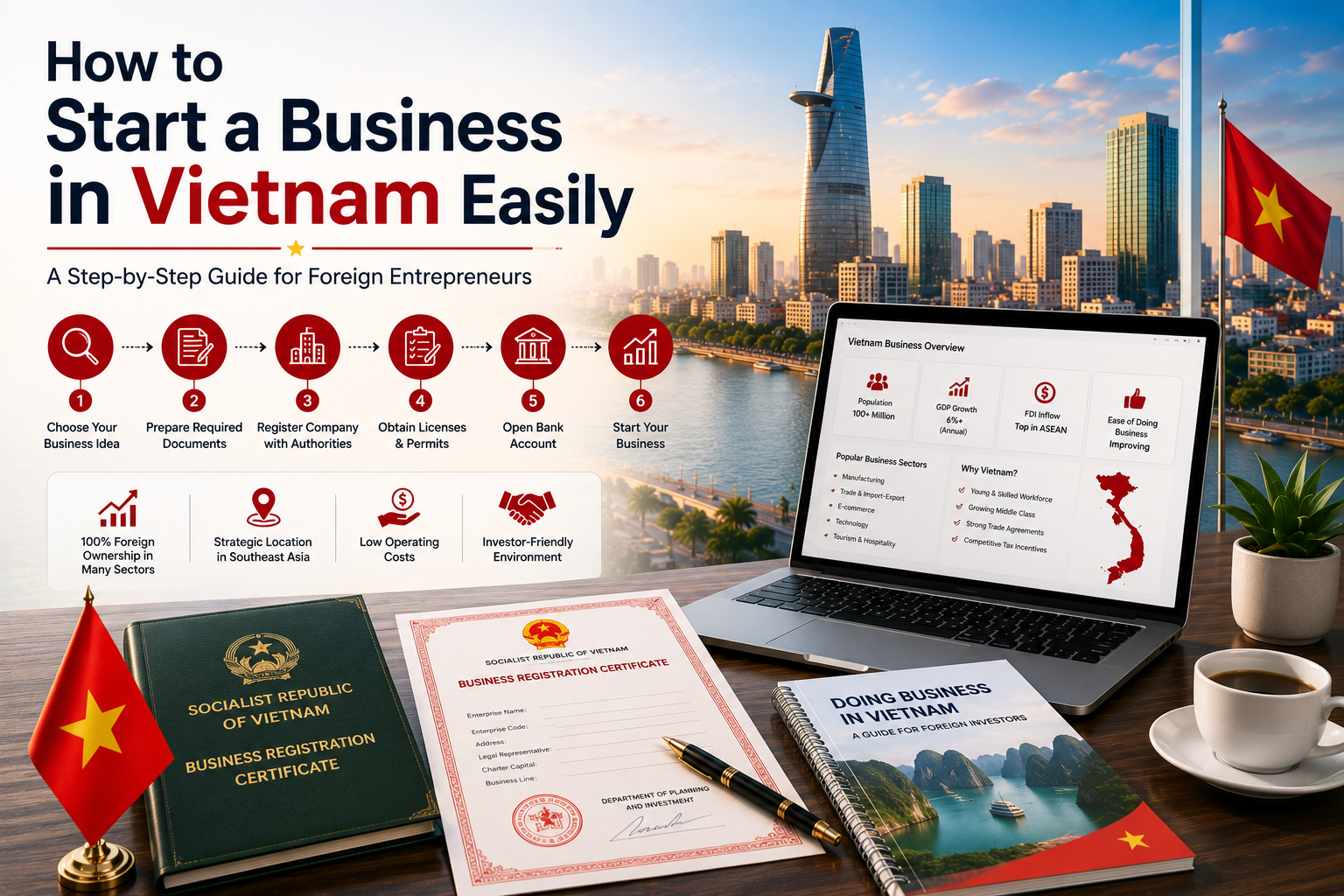
How to Start a Business in Vietnam Easily
Vietnam has always been an attractive place to build a business competitive costs, a young workforce, and trade agreements like the CPTPP and EVFTA opening doors across major markets. What’s changed recently is the process itself. A significant investment law reform took effect on March 1, 2026, and it genuinely made things easier for foreign founders, provided you know the new rules rather than following outdated advice built around the old system.
Start by Checking If Your Sector Is Even Restricted
Before anything else, find out where your business fits under Vietnam’s foreign investment framework. Vietnam uses what’s called a “negative list” approach: unless your specific activity is explicitly restricted or conditional, you’re entitled to the same treatment as a domestic investor, including full 100% foreign ownership. How to start a business in Vietnam short list of sectors certain media, defense-adjacent industries, some financial services carry real restrictions or require a local partner, but the vast majority of businesses, from software to manufacturing to consulting, fall outside those limits entirely. Confirming this early saves you from planning around a restriction that simply doesn’t apply to you.
The Genuinely Big Change: You Don’t Have to Wait Anymore
Here’s the part that makes “easily” a fair word to use in 2026: under the old system, foreign investors had to get their Investment Registration Certificate (IRC) approved before they could even form the actual company. That meant weeks of waiting before you could open a bank account, sign a lease, or do anything that looked like real business activity. The 2025 investment law reform flipped that order. Investors can now obtain their Enterprise Registration Certificate first — legally forming the company — and handle IRC procedures for the specific investment project afterward, as long as basic market access conditions are met. In practical terms, this means you can get your company legally standing while the more detailed project approval is still moving through the system, rather than everything being stuck behind a single gate.
The Steps, Once You Understand the New Order
With that sequencing understood, the actual mechanics are fairly clear. You’ll need to settle on a structure — most foreign founders choose an LLC, since Vietnam has no general minimum capital requirement for most business lines and it offers straightforward liability protection. From there, you prepare your company documentation, confirm a legitimate business address (residential apartments generally don’t qualify), and file your Enterprise Registration Certificate application. A precise, detailed description of your business activities matters more than people expect here — vague terms like “consulting services” without specifics are one of the most common triggers for authorities to request additional clarification, and each round of back-and-forth can add another week or more to your timeline.
The One Requirement That Trips Up Newcomers
If there’s a single detail that catches foreign founders off guard in 2026, it’s this: Vietnam now requires all company registration filings, including the ERC application, to go through a national electronic identification system tied to an individual’s VNeID. The older corporate portal accounts that used to handle this were phased out in mid-2025. This means you need a Vietnamese representative with valid eID credentials lined up before you file — not something to discover halfway through your application.
Don’t Forget the Clock Starts After Incorporation
Once your company is registered, you have 90 days to actually contribute your registered charter capital, transferred through a Direct Investment Capital Account at a licensed Vietnamese bank. This isn’t a soft deadline comply globally missing it can trigger a fine and a forced reduction of your registered capital to whatever was actually paid in. It’s worth building this into your planning from day one rather than treating it as a later formality, especially since international wire transfers can occasionally take longer than founders expect.
A Small but Real Bonus
As of January 1, 2026, Vietnam also eliminated the old annual business license fee that used to be a standard, if minor, recurring cost for every registered company. It’s not a dramatic saving on its own, but it’s one more sign of a regulatory system that’s genuinely being simplified rather than just talked about.
The Honest Bottom Line
Starting a business in Vietnam in 2026 really is easier than it used to be — full ownership in most sectors, a faster path to legal incorporation thanks to the ERC-first reform, and no minimum capital hurdle for most business types. The founders who experience it as easy are the ones who register their eID access early, write precise business activity descriptions, and treat the 90-day capital deadline as a real commitment rather than a formality. Get those three things right, and Vietnam’s newly streamlined system delivers close to what its reputation promises.