
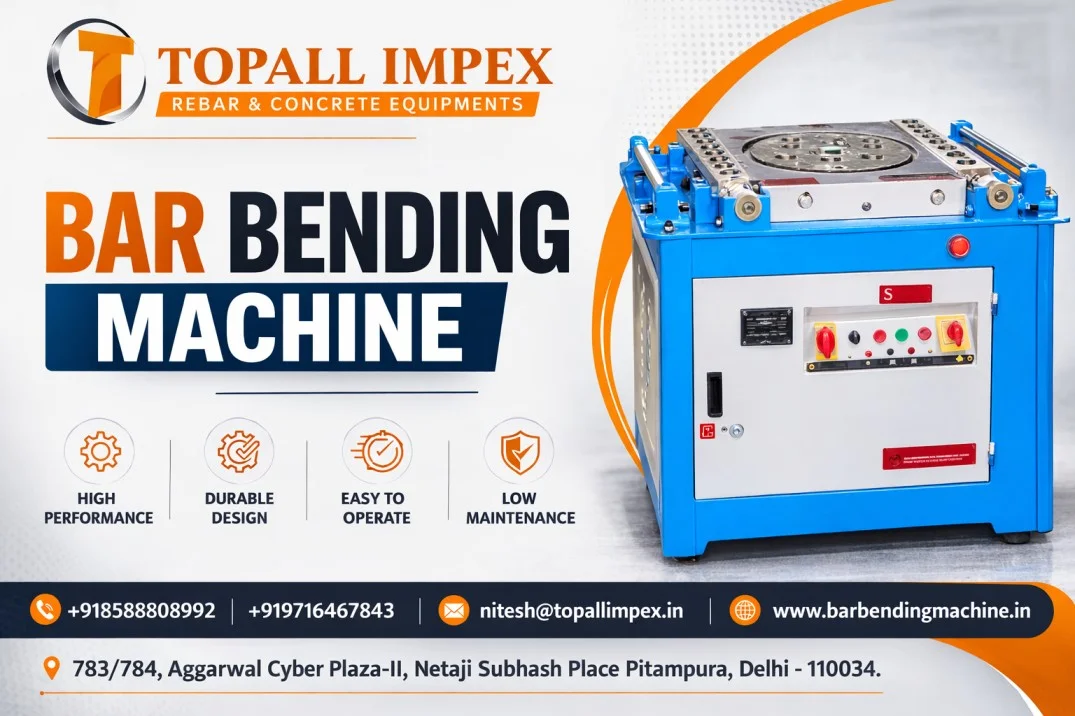
Bar Bending Machine Specifications: Complete Buying Guide
Choosing the right bar bending machine is an important decision for construction companies, contractors, fabricators, and reinforcement steel processing businesses. The right machine can improve productivity, reduce manual effort, deliver accurate bends, and minimize material wastage.
However, comparing machines based only on price can lead to the wrong purchase. Specifications such as bar diameter, bending capacity, motor power, bending angle, disc diameter, operating speed, and automation level directly affect machine performance.
Before investing in a bar bending machine, it is therefore important to understand what each specification means and how it relates to your actual construction requirements.
What Is a Bar Bending Machine?
A bar bending machine is construction equipment designed to bend steel reinforcement bars, commonly known as rebars, into required angles and shapes. These bends are used in reinforced concrete structures such as columns, beams, slabs, foundations, bridges, and other infrastructure projects.
Compared with manual bending, a machine provides better consistency, faster processing, and reduced physical effort. Depending on the model, machines may be manual, semi-automatic, or fully automatic.
The machine you select should match the diameter and type of bars you regularly process, your required production volume, available power supply, and project requirements.
Key Bar Bending Machine Specifications to Check
1. Maximum Bending Capacity
One of the first specifications to check is the maximum bar diameter the machine can bend.
Different machines are designed for different bar sizes. For example, a machine may be suitable for bars up to 20 mm, 32 mm, 40 mm, or larger, depending on its design and power.
When checking capacity, don’t select a machine based only on the largest bar you currently use. Consider your future projects as well.
Tip: Choose a machine with sufficient capacity for your regular workload without unnecessarily purchasing a much larger machine.
2. Bending Range
The bending range indicates the size or diameter range of reinforcement bars that the machine can process effectively.
A machine with a wider working range can handle different bar sizes, making it more versatile for contractors working on multiple types of projects.
Check both the minimum and maximum recommended bar sizes before purchasing.
3. Maximum Bending Angle
The bending angle determines how far the machine can bend a steel bar.
Common reinforcement applications may require bends such as 45°, 90°, 135°, or 180°. Some advanced machines can provide programmable or highly controlled bending angles.
If your projects involve stirrups, hooks, columns, beams, or complex reinforcement cages, accurate angle control becomes particularly important.
4. Motor Power
Motor power is another important specification because it affects the machine’s ability to bend reinforcement bars.
Machines with higher motor power are generally designed to handle heavier workloads and larger bar diameters. However, higher power does not automatically mean better performance for every application.
Consider:
- Maximum bar diameter
- Required production volume
- Frequency of operation
- Electrical supply available at your site
- Type and grade of steel being processed
Choosing the appropriate motor capacity helps balance performance and operating requirements.
5. Bending Speed
Bending speed determines how quickly the machine can complete a bending operation.
For small construction projects, extremely high speed may not be necessary. However, for large infrastructure projects, fabrication yards, and high-volume reinforcement work, faster bending can significantly improve productivity.
Look at the complete operating cycle rather than focusing only on the advertised maximum speed.
6. Working Disc Diameter
The working disc diameter is another specification commonly mentioned in bar bending machine catalogs.
The disc is involved in positioning and bending the reinforcement bar. Its dimensions and configuration can influence the machine’s bending capability and suitability for different applications.
When comparing two machines, don’t evaluate disc diameter alone. Consider it alongside bending capacity, bar diameter, motor power, and machine design.
7. Number of Bending Speeds
Some machines provide different operating speeds, while others may have a fixed speed.
Variable-speed functionality can provide greater control for different applications. It may be particularly useful when working with different bar sizes or when accuracy and production requirements vary.
Ask the manufacturer how the available speeds correspond to the machine’s recommended operating conditions.
8. Control System and Automation
Bar bending machines are available with different levels of automation.
Manual machines generally require more operator involvement.
Semi-automatic machines provide additional mechanical or electrical assistance while still requiring operator control.
Automatic or CNC machines can provide programmable bending sequences, improved repeatability, and greater productivity for high-volume applications.
Your choice should depend on production requirements, budget, operator skills, and the complexity of the bending work.
9. Machine Dimensions and Weight
Never overlook the physical dimensions of the machine.
Before ordering, check:
- Overall machine length
- Width and height
- Machine weight
- Working area required
- Material loading space
- Access for maintenance
- Transportation requirements
A heavy-duty machine may offer excellent performance but could be unsuitable for a site with limited space or inadequate floor capacity.
10. Power Supply Requirements
Check whether the machine requires a single-phase or three-phase electrical connection and confirm its voltage and power requirements.
Construction sites may have different electrical infrastructure from permanent manufacturing facilities. Selecting a machine that matches your available power supply can prevent installation and operational problems.
Always verify electrical specifications with the manufacturer before installation.
Why Accuracy Matters in Bar Bending
Accurate bending is essential when reinforcement bars must follow engineering drawings and structural requirements.
Incorrect bending angles or dimensions can result in:
- Material wastage
- Rework
- Construction delays
- Increased labor costs
- Difficulty during reinforcement placement
A machine with reliable angle control and repeatable operation can help maintain consistency across multiple bars.
How to Compare Two Bar Bending Machines
Suppose you are comparing two machines. Instead of looking only at their prices, create a specification comparison based on your actual requirements.
Compare:
| Specification | Machine A | Machine B |
|---|---|---|
| Maximum Bar Capacity | Check | Check |
| Bending Range | Check | Check |
| Bending Angle | Check | Check |
| Motor Power | Check | Check |
| Bending Speed | Check | Check |
| Working Disc Diameter | Check | Check |
| Automation Level | Check | Check |
| Power Requirement | Check | Check |
| Machine Weight | Check | Check |
| Warranty & Service | Check | Check |
This approach makes it easier to identify which machine provides better value for your specific application.
Don’t Ignore Build Quality
Specifications are important, but construction quality also matters.
A bar bending machine used in demanding environments should have a robust frame, reliable electrical components, durable bending components, and appropriate safety features.
Ask the supplier about the materials used, manufacturing process, quality testing, spare parts availability, and expected service requirements.
Check After-Sales Support
A machine is a long-term investment. Therefore, after-sales support should be part of your buying decision.
Before purchasing, ask about:
- Installation support
- Operator training
- Warranty coverage
- Spare parts availability
- Technical assistance
- Maintenance support
- Service response time
A slightly cheaper machine may become expensive if spare parts and technical support are difficult to obtain.
Common Mistakes to Avoid
Many buyers make the mistake of choosing a machine solely according to its purchase price.
Other common mistakes include:
- Buying a machine with insufficient bar capacity.
- Ignoring power requirements.
- Not checking bending accuracy.
- Overlooking machine dimensions.
- Choosing unnecessary capacity for a small operation.
- Ignoring warranty and service support.
- Not checking spare-parts availability.
- Failing to consider future production requirements.
A detailed specification comparison can help prevent these issues.
Final Thoughts
Understanding bar bending machine specifications is essential before making a purchase. Capacity, bending range, motor power, bending angle, speed, working disc diameter, automation, dimensions, and power requirements all influence machine performance.
The best machine is not necessarily the largest or most expensive model. It is the one that matches your bar sizes, production volume, project requirements, workspace, electrical supply, and budget.
Before placing an order, compare technical specifications carefully and discuss your application with the manufacturer or supplier. A properly selected bar bending machine can improve productivity, consistency, and efficiency while reducing manual labor and rework.
Ready to choose the right bar bending machine? Compare specifications, check your project requirements, and consult a trusted manufacturer before making your purchase.