
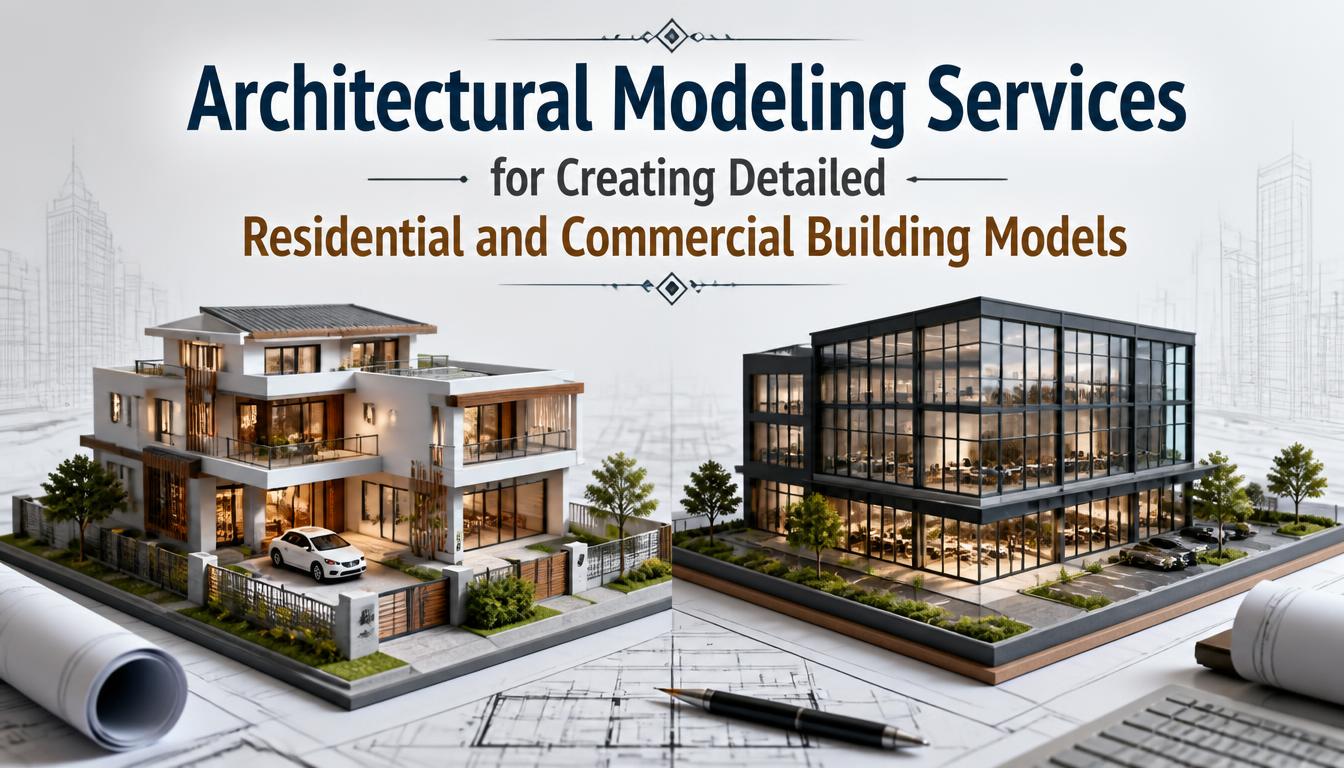
Architectural Modeling Services for Creating Detailed Residential and Commercial Building Models
Architectural modeling services help bring flat drawings to life. The process matters for both single-family homes and offices.
This guide breaks down real modeling ideas for both building types, backed by verified data instead of studio guesswork.
Which Modeling Ideas Work Best For Each Building Type?
Residential and commercial projects require different levels of accuracy in the model used. A model for a house is likely to focus on materials and mood, while a commercial model will have to do more with layout and functionality. The value of architectural modeling is matching the idea with the type of building.
| Idea | Best Use | Building Type |
| Exterior material studies | Testing siding, brick, or stone options | Residential |
| Interior daylight walkthroughs | Showing room flow and window placement | Residential |
| Floor-by-floor massing models | Reviewing overall building footprint | Commercial |
| Lobby and entry sequence views | Presenting first-impression spaces to stakeholders | Commercial |
| Site context models | Placing the building within its surroundings | Both |
Choosing between these ideas usually comes down to who’s reviewing the model. Homeowners respond to atmosphere, while commercial stakeholders respond to layout and circulation.
What Do The Numbers Say About Demand For These Services?
Construction spending keeps splitting between residential and commercial work, and the workforce building both is growing. The following table will shed light on the growth trend of these services.
| Data Point | Detail | Source |
| 2025 residential construction spending | $905.2 billion in the U.S. | U.S. Census Bureau |
| 2025 nonresidential construction spending | $742.4 billion in the U.S. | U.S. Census Bureau |
| Architect jobs, 2024 | 123,600 jobs, projected to grow 4% through 2034 | U.S. Bureau of Labor Statistics |
In 2025, construction activities generated over $1.65 trillion in revenue. Given the high level of construction going on across these two different categories of projects, a one-size-fits-all model isn’t enough, and a workforce projected to grow 4% requires better ways to communicate with clients. The role of Building information modelling (BIM) technology is gaining importance in this area. Many organizations now create their visualizations using the information provided by BIM technology and not through any other file format.
What Makes Residential Models Different From Commercial Ones?
The differences go beyond scale. A house model usually serves one decision-maker, while a commercial model often serves a whole committee. Architectural design choices get reviewed very differently depending on the audience.
- Residential models emphasize mood, texture, and personal taste.
- Commercial models emphasize wayfinding, capacity, and code compliance.
- Residential reviews are usually one-on-one with the owner.
- Commercial reviews often involve multiple stakeholders and departments.
- Commercial models frequently need phased or multi-floor views.
Which Details Matter Most Before Construction Begins?
Small details in a model prevent bigger problems later. Skipping them tends to surface as change orders once work is underway. Getting these right before groundbreaking saves both time and budget.
- Accurate window and door placement for daylight studies.
- Correct material textures, not placeholder finishes.
- True-to-scale furniture or fixtures for spatial context.
- Site grading and landscaping shown at the right scale.
- Structural elements that match the engineer’s actual drawings.
Building visualization done at this level gives clients a far more honest preview than a flat rendering ever could. SMA Archviz builds architectural modeling services around exactly this level of residential and commercial detail.
Final Thoughts
It is detail that makes a good model rather than a mere picture, whether for a house or a commercial property. Choosing the right ideas for each building type, backed by real construction and workforce data, is what makes architectural modeling services worth the investment. The right level of detail upfront saves headaches later.