
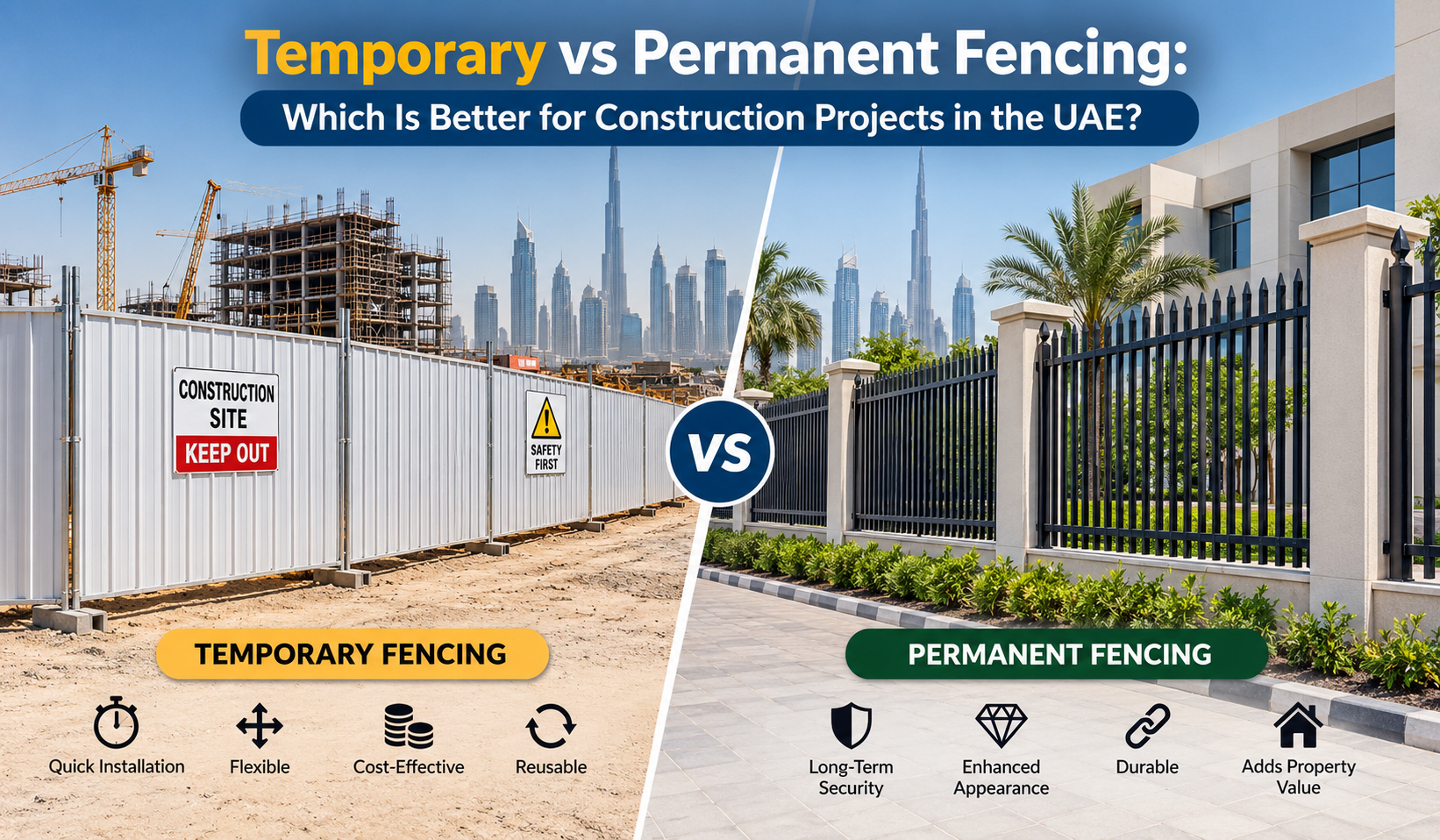
Temporary vs Permanent Fencing: Which Is Better for Construction Projects in the UAE?
Construction sites in the UAE need more than basic barriers around their boundaries. A suitable fence helps control access, protect workers and visitors, secure equipment, maintain privacy, and keep the surrounding area safe. But when planning a project, one important question often comes up: should you use temporary or permanent fencing?
The answer depends on the type of construction project, how long the site will remain active, the level of security required, and what will happen to the property after construction is complete.
Temporary fencing is generally designed for projects where the boundary will only be needed for a limited period. Permanent fencing, on the other hand, is installed as a long-term perimeter solution and usually becomes part of the finished property.
Understanding the difference between the two can help contractors, developers, and property owners choose a fencing system that fits both their project requirements and budget.
What Is Temporary Construction Fencing?
Temporary construction fencing is designed to provide perimeter protection for a site during a specific phase of a project. It can be installed relatively quickly and removed, relocated, or reused when the site requirements change.
This type of fencing is particularly useful for construction sites, infrastructure projects, roadwork, events, vacant plots, and temporary storage areas.
Depending on the application, temporary fencing may use materials such as PPGI panels, galvanized steel, mesh panels, or other modular systems. Some systems can also include gates, warning signs, branding panels, and additional security features.
One of the biggest advantages of temporary fencing is flexibility. A construction site rarely stays the same throughout a project. Access points can move, work zones can expand, and sections of the site may need to be opened or closed. A modular temporary fence makes these changes easier to manage.
What Is Permanent Fencing?
Permanent fencing is intended to remain in place for many years. Instead of being removed after construction, it normally becomes part of the property’s long-term security, privacy, or boundary system.
Permanent fencing is commonly used around villas, commercial properties, warehouses, factories, schools, industrial facilities, residential developments, and other completed properties.
The choice of material can vary considerably. Depending on the required appearance and level of protection, options may include aluminum fencing, cast iron fencing, welded mesh, chain link fencing, anti-climb systems, or other steel-based solutions.
Because permanent fencing is expected to provide long-term performance, factors such as corrosion resistance, structural strength, appearance, maintenance, and compatibility with gates should be considered before installation.
Temporary vs Permanent Fencing: The Main Differences
Although both systems provide perimeter protection, they serve different purposes.
| Factor | Temporary Fencing | Permanent Fencing |
|---|---|---|
| Intended use | Short- or medium-term projects | Long-term property protection |
| Installation | Usually quicker and more flexible | Requires more planning and preparation |
| Relocation | Can often be moved or reconfigured | Generally remains in one location |
| Reuse | Many systems can be reused | Usually designed for one permanent installation |
| Appearance | Primarily functional | Can be designed to complement the property |
| Security | Depends on the system selected | Can provide higher long-term security |
| Cost approach | Practical for temporary requirements | Better suited to long-term investment |
| Typical users | Contractors and project managers | Property owners and developers |
The right choice is therefore less about deciding which fence is universally better and more about determining which one makes sense for the specific project.
When Is Temporary Fencing the Better Choice?
1. Short-Term Construction Projects
If a site will only be active for a few months, investing in a permanent boundary may not be practical.
Temporary construction fencing can provide the required level of separation and security while the work is underway. Once the project reaches completion, the fence can be removed and replaced with the property’s final boundary system if necessary.
2. Projects With Changing Site Layouts
Construction sites change constantly. Material storage areas may move, machinery routes may change, and contractors may need to create new access points.
A flexible temporary fencing system allows sections to be repositioned without rebuilding the entire perimeter.
This is particularly useful for large projects where different construction phases require different site layouts.
3. Projects Requiring Quick Installation
Construction schedules in the UAE can be demanding. Delays in establishing site boundaries can create unnecessary safety and security concerns.
Temporary fencing systems are often designed for straightforward installation, making them suitable when a site needs to be secured quickly before major work begins.
4. Temporary Storage or Restricted Areas
Not every fenced area is intended to become a permanent boundary.
Contractors may need to isolate construction materials, machinery, excavation areas, loading zones, or restricted sections of a project. Temporary fencing can create these controlled areas without committing to a permanent structure.
5. When Reuse Matters
A contractor working on multiple projects may benefit from fencing that can be dismantled and used again.
Instead of treating the fence as a one-time installation, a reusable temporary system can become part of a company’s equipment inventory.
When Is Permanent Fencing the Better Choice?
1. Long-Term Security Requirements
If a property needs continuous protection after construction is completed, permanent fencing is usually the more appropriate option.
Industrial facilities, warehouses, commercial properties, and residential developments may need a boundary that remains in place for years. A properly selected permanent fence can provide security without requiring repeated installation and removal.
2. Properties Where Appearance Matters
A construction fence is mainly functional. A finished property’s boundary may also need to contribute to its overall appearance.
For villas, offices, commercial developments, and public-facing properties, permanent fencing can be selected according to the building’s architecture and surrounding landscape.
Materials, finishes, fence height, gate design, and other details can be coordinated to create a more finished appearance.
3. Industrial and High-Security Sites
Some facilities require more than a basic boundary. Warehouses, factories, utility facilities, and restricted areas may require fencing that makes climbing, cutting, or unauthorized access more difficult.
Anti-climb and welded mesh fencing can be considered where stronger perimeter security is needed. The appropriate solution will depend on the site’s risk level and access-control requirements.
4. New Developments With a Defined Final Layout
When a development’s boundaries, entrances, and internal layout are already established, permanent fencing can be planned alongside the rest of the property.
This approach allows the fence, gates, access points, and security arrangements to work together rather than treating the boundary as an afterthought.
How UAE Weather Should Influence Your Decision
The UAE’s climate is an important consideration when selecting outdoor fencing.
High temperatures, intense sunlight, dust, humidity in coastal areas, and occasional exposure to moisture can all affect outdoor materials over time. A fence that performs well in one environment may require different specifications in another.
For both temporary and permanent applications, the material and protective finish should be considered carefully.
Galvanized and coated steel systems, for example, are commonly used for outdoor applications because appropriate protective treatments can help improve resistance to corrosion. However, the actual performance depends on the material specification, coating quality, installation, location, and maintenance.
For a long-term installation, it is particularly important to discuss environmental conditions with the fencing supplier before choosing the final material.
Security Should Come Before Appearance
A visually attractive fence is not necessarily a secure fence.
Before selecting a fencing system, project managers should identify what the boundary needs to achieve. Is it mainly intended to stop people from entering a construction area? Does it need to prevent unauthorized vehicle access? Is privacy important? Does the site contain expensive machinery or materials?
For a construction site, the fence may need to discourage trespassing and clearly separate active work areas from public spaces.
For an industrial facility, the focus may shift toward stronger anti-climb and access-control measures.
For a residential property, privacy and appearance may carry greater weight.
The best security fencing in the UAE is therefore not necessarily the heaviest or most expensive option. It is the system that matches the actual risks and requirements of the property.
Cost: Temporary or Permanent Fencing?
Cost is one of the first factors most project managers consider, but looking only at the initial purchase price can be misleading.
Temporary fencing can be more economical for short-term projects because it avoids the cost and permanence of a finished boundary. If the fencing can be dismantled and reused, its value may extend across several projects.
Permanent fencing, meanwhile, involves a longer-term investment. Installation may require additional preparation, foundations, posts, gates, and finishing work depending on the design.
The right comparison should therefore consider the total cost over the expected lifespan of the fence, rather than simply comparing the initial price.
For example, using a permanent fence for a short construction project may result in unnecessary expenditure. Likewise, repeatedly renting or replacing temporary fencing around a property that requires permanent security may become expensive over time.
Don’t Forget About Gates and Access Points
A fence is only one part of a site’s perimeter security.
Construction projects need controlled access for workers, contractors, delivery vehicles, and visitors. The gate system should therefore be considered at the same time as the fencing.
Temporary projects may require removable or repositionable gates that can accommodate changing vehicle routes.
Permanent properties may need pedestrian gates, sliding gates, vehicle entrances, or automated access systems depending on their use.
Poorly planned access points can undermine an otherwise strong perimeter, so gate locations should be established based on traffic flow, emergency access, security procedures, and the site’s operational needs.
Temporary Fencing Can Also Be a Long-Term Project Solution
The word “temporary” does not necessarily mean the fence will only be used for a few weeks.
Large construction and infrastructure projects can continue for years. During that time, the site may still require a boundary that can adapt to different construction phases.
This is where temporary fencing can provide a practical advantage. Instead of committing to a fixed perimeter before the project layout is finalized, contractors can use modular fencing and adjust it as work progresses.
In this situation, the important question is not simply how long the fence will be installed. It is whether the site’s requirements are likely to change.
A Practical Decision-Making Checklist
Before choosing between temporary and permanent fencing, ask the following questions:
How long will the fence be needed?
If the boundary is only required during construction, temporary fencing may be more suitable. If it will remain after handover, permanent fencing is usually worth considering.
Will the site layout change?
If access routes, storage areas, or work zones will move during construction, flexibility should be a priority.
What level of security is required?
Identify whether the fence needs to provide basic separation, privacy, controlled access, or a higher level of perimeter protection.
What environmental conditions will it face?
Consider heat, dust, humidity, coastal exposure, and other local conditions when selecting materials and protective finishes.
Does the fence need to match the finished property?
If appearance is an important part of the project, permanent fencing offers more opportunities for design customization.
Can the fencing be reused?
For contractors managing multiple sites, reusable temporary fencing can provide additional value.
What type of access will the site require?
Plan gates and vehicle entrances alongside the fence instead of adding them later.
Which Fencing Option Is Best for Construction Projects in the UAE?
There is no single answer for every construction project.
Temporary fencing is generally the better choice when flexibility, fast installation, relocation, and short- or medium-term site security are the main priorities. It works particularly well for active construction zones, temporary storage areas, infrastructure projects, and sites where the layout is still changing.
Permanent fencing is generally the better choice when the boundary needs to remain in place after construction and provide long-term security, privacy, or visual appeal. It is more suitable for completed residential, commercial, and industrial properties with established layouts.
In some projects, the most practical approach is to use both. Temporary fencing can protect the site during construction, while permanent fencing is installed as the final property boundary when the project reaches the appropriate stage.
Choosing the Right Fencing Supplier
The quality of the final result depends not only on the type of fence but also on how well the system is specified, supplied, and installed.
A reliable fencing supplier in the UAE should be able to explain the differences between available materials, recommend options based on the site conditions, and provide the accessories and gates needed for a complete perimeter solution.
It is also worth checking whether the supplier can handle transportation and installation. Having these services coordinated through one provider can make project planning easier and reduce the risk of mismatched components.
Companies such as Vertex Fence provide different fencing systems for construction, industrial, commercial, and other applications, including temporary and permanent options. The important point is to select the product based on the project’s actual requirements rather than choosing a fence simply because it is commonly used.
Final Thoughts
The temporary versus permanent fencing decision should be made early in the construction planning process.
Temporary fencing offers flexibility and practicality when the site is changing or the boundary is only needed during construction. Permanent fencing provides a long-term solution when security, privacy, appearance, and property boundaries need to remain in place for years.
For UAE construction projects, material selection, weather exposure, security requirements, installation, access control, and total cost should all be considered before making the final decision.
The best fencing solution is ultimately the one that protects the site effectively, fits the project’s timeline and budget, and continues to perform as the property moves from construction to its next stage.