
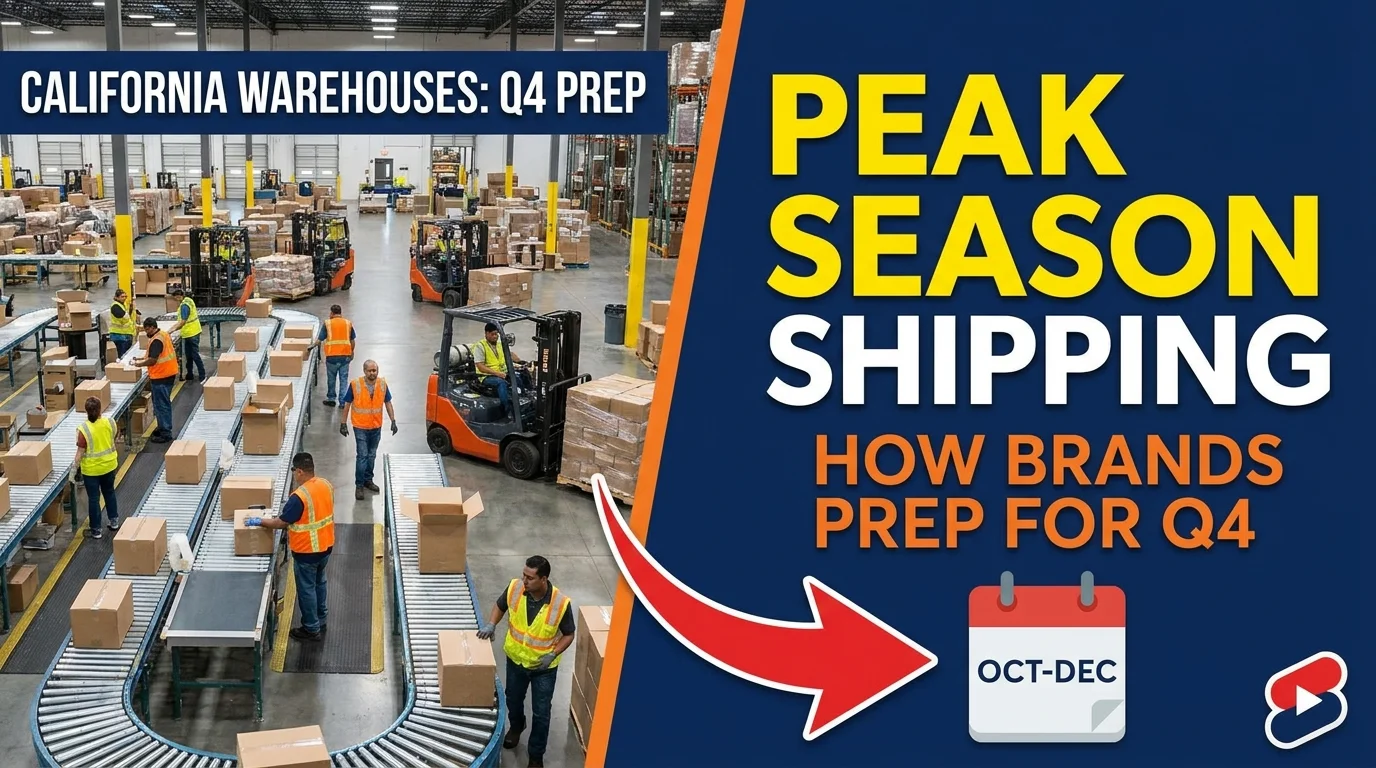
Peak Season Shipping in California: How Brands Prep Warehouses for Q4
Q4 makes or breaks a lot of ecommerce brands. Black Friday, Cyber Monday, and the holiday shopping rush can bring in more revenue in six weeks than the rest of the year combined. But that surge only turns into profit if orders actually leave the warehouse on time.
In California, peak season shipping comes with its own set of pressures. Port congestion at Long Beach and Los Angeles, tight labor markets, and carrier rate hikes all stack on top of the usual holiday order spike. Brands that wait until October to think about Q4 are already behind.
This guide walks through how experienced California warehouses and fulfillment teams actually prepare for peak season, what tends to go wrong, and what separates a smooth Q4 from a chaotic one.
Why Peak Season Shipping Hits California Warehouses Differently
California isn’t just another state on the map when it comes to logistics. It’s the entry point for a huge share of everything imported into the U.S.
A few things make Q4 prep here more complicated than in other regions:
- Port dependency. The Ports of Los Angeles and Long Beach handle a massive volume of inbound freight. Any slowdown there in September or October ripples straight into November fulfillment.
- Carrier peak surcharges. UPS, FedEx, and other national carriers apply demand surcharges and dimensional weight adjustments during peak weeks, and California’s shipping volume makes the state a major factor in how those surcharges get set.
- Labor competition. Warehouses in Southern California compete with retail, hospitality, and last-mile delivery companies for the same seasonal workforce every Q4.
- Real estate cost. Warehouse space in the Inland Empire, Orange County, and the LA Basin is expensive and often fully leased well before October, so brands that need overflow space late in the season are stuck.
Understanding these regional pressures is the first step. The second is building a plan around them months in advance.
When Should Brands Start Prepping for Q4?
Most experienced fulfillment operators start peak season planning in July or August, not October. Here’s a rough timeline that works for most ecommerce brands:
| Timeframe | What to Focus On |
|---|---|
| July – August | Forecast demand, lock in warehouse space, confirm carrier contracts |
| September | Finalize SKU strategy, pre-build kits and bundles, start staffing |
| Early October | Receive and put away peak inventory, test systems under load |
| Mid-to-Late October | Run mock peak days, finalize packaging and labeling standards |
| November – December | Execute, monitor daily metrics, manage exceptions in real time |
| January | Debrief, process returns, document lessons for next year |
Brands that start this process in October instead of July usually end up paying rush freight rates, scrambling for temp labor, and missing SLA windows during the busiest two weeks of the year.
Step 1: Forecast Demand Before You Touch Inventory
Everything else in Q4 prep depends on getting the forecast right. Overestimate and you’re paying for warehouse space and inventory you don’t need. Underestimate and you’ll stock out during your highest-revenue week.
A solid forecast usually blends:
- Last year’s sales data, adjusted for growth or decline
- Planned promotions and marketing spend for Black Friday and Cyber Monday
- New product launches that don’t have historical data
- Category trends (some product types spike harder than others in Q4)
Expert tip: Break your forecast down by SKU, not just total revenue. A brand can hit its overall sales target while completely missing the mark on which specific products sell, which leads to stockouts on bestsellers and dead inventory on slow movers.
Step 2: Secure Warehouse Space Early
Warehouse capacity in California tightens fast heading into Q4. Facilities that handle seasonal overflow for multiple clients often fill up by September, especially in the Inland Empire where bulk storage is in high demand.
If a brand is working with a 3PL, this is the point to confirm:
- Whether current space covers peak inventory levels
- Whether the 3PL has overflow capacity if forecasts run high
- Cutoff dates for receiving inbound freight before the season ramps up
Brands managing their own warehousing and storage should also map out racking capacity, staging areas for peak inventory, and floor space for returns, since Q4 returns volume often shows up faster than people expect in January.
Step 3: Lock In Carrier Capacity and Rates
Carriers publish peak season surcharge schedules months in advance, and they apply to nearly every shipment during specific weeks in November and December. These surcharges stack on top of standard rates and can add real cost per package if they’re not planned for.
Steps that help:
- Review last year’s carrier invoices to understand exactly where surcharges hit hardest.
- Diversify carriers so no single peak surcharge or service disruption takes down the whole operation.
- Negotiate rates before peak season officially begins, not during it.
- Confirm cutoff dates for guaranteed holiday delivery windows and communicate them to customers early.
Common mistake: Relying on a single carrier for all Q4 volume. If that carrier hits a service disruption during peak week, there’s no backup plan and orders sit.
Step 4: Prep Inventory, Kitting, and SKU Strategy
Peak season isn’t the time to be assembling bundles or building kits on the fly. Any product that requires kitting, poly bagging, or multi-item bundling should be prepped and ready to ship before November hits.
Practical steps warehouses take:
- Pre-kit bundles and gift sets in September and October, before order volume climbs
- Slot fast-moving SKUs closer to packing stations to cut pick time
- Flag seasonal or promotional SKUs so pickers aren’t hunting for unfamiliar products mid-rush
- Run a full cycle count before peak season starts, so inventory records match physical stock
For brands selling on Amazon, this is also the window to confirm FBA prep requirements are met well ahead of Amazon’s own Q4 inventory restrictions and cutoff dates.
Step 5: Staff Up Before You Need To
Labor is usually the tightest constraint during California peak season. Warehouses across Southern California are all hiring seasonal staff at the same time, and the good candidates go fast.
A few things that make seasonal staffing work better:
- Start recruiting in September, not late October
- Cross-train staff across receiving, picking, packing, and shipping so people can shift where the bottleneck is
- Bring temp staff on early enough to train them before peak volume hits, not during it
- Build in overtime and shift flexibility for the two or three heaviest weeks
Expert tip: Run at least one full mock peak day in October at expected volume. This surfaces bottlenecks in picking paths, packing stations, and shipping docks while there’s still time to fix them.
Step 6: Stress-Test Systems and Processes
A warehouse management system that works fine at normal volume can slow to a crawl at 3x order volume. Before peak season hits, test:
- Order processing speed under simulated high volume
- Barcode scanning and label printing under continuous use
- Integration reliability between the storefront (Shopify, Amazon, WooCommerce, and similar platforms) and the WMS
- Backup procedures if internet, power, or system access goes down mid-shift
Brands using automated order routing should also confirm that platform integrations are syncing correctly. A missed sync during peak week can mean hundreds of unprocessed orders piling up before anyone notices.
Step 7: Plan for Returns Before They Arrive
Q4 returns volume climbs fast in January, and warehouses that don’t plan for it end up with a backlog that delays restocking and ties up cash in unsellable inventory.
Before the season starts, confirm:
- Where returned inventory will be received and inspected
- How quickly items need to be restocked to be sellable again
- Return policies that are clearly communicated to customers at checkout
Returns processing that takes weeks instead of days quietly erodes Q4 profit long after the holiday rush is over.
Common Mistakes Brands Make During Peak Season
| Mistake | Why It Hurts |
|---|---|
| Starting prep in October | Warehouse space and carrier capacity are already tight by then |
| Forecasting by total revenue only | Leads to stockouts on bestsellers, overstock on slow movers |
| Relying on one carrier | No backup if that carrier hits delays or service issues |
| Skipping a mock peak day | Bottlenecks surface for the first time during actual peak volume |
| Ignoring returns planning | January backlog delays restocking and ties up cash |
| Under-staffing packing stations | Orders back up even when picking keeps pace |
Actionable Takeaways
- Start Q4 planning in July or August, not October.
- Forecast demand by SKU, not just by overall revenue.
- Confirm warehouse space and carrier rates before peak surcharges apply.
- Pre-kit bundles and seasonal SKUs well before order volume spikes.
- Recruit and cross-train seasonal staff early.
- Run at least one mock peak day to surface bottlenecks.
- Build a returns plan before January arrives, not after.
Frequently Asked Questions
When should ecommerce brands start preparing for Q4 peak season? Most experienced operators start in July or August. Warehouse space, carrier rates, and seasonal labor all tighten up as the season approaches, so early planning avoids rushed decisions and higher costs later.
What is peak season shipping surcharge, and how does it affect California brands? Peak season surcharges are temporary rate increases that carriers like UPS and FedEx apply during high-volume weeks in November and December. Brands shipping high volumes out of California should review last year’s invoices and factor these surcharges into Q4 budgeting.
How much extra warehouse space do brands typically need for Q4? This depends heavily on the brand’s forecasted growth and product mix, but many brands need 20 to 50 percent more storage capacity during peak months compared to their baseline. Confirming space early with a warehouse partner avoids last-minute scrambling.
What’s the biggest mistake brands make with Q4 warehouse prep? Waiting too long to start. By the time October arrives, warehouse space, carrier capacity, and seasonal labor are already tightening across California, which limits options and drives up cost.
How do 3PLs help brands handle peak season shipping? A 3PL with established warehouse space, carrier relationships, and seasonal staffing plans can absorb a lot of the operational strain that would otherwise fall on an in-house team. This is especially useful for brands without the infrastructure to scale quickly for two or three months a year.
Do returns need to be planned for before peak season even starts? Yes. Return volume typically climbs fast in January, and warehouses that haven’t planned staffing and space for returns processing end up with backlogs that delay restocking.
How early should seasonal staff be hired for peak season warehouses? September is a realistic target for most Southern California warehouses. Waiting until November means competing for the same limited labor pool that retail and last-mile delivery companies are also hiring from.
Should brands use multiple carriers during peak season? Yes, in most cases. Relying on a single carrier creates risk if that carrier experiences delays or service disruptions during the busiest shipping weeks of the year.