
What Does a Professional Concrete Estimator Include in a Detailed Estimate?
Concrete work is one of the most significant aspects of the construction process. It is used to support foundations, slabs, walls, driveways, columns, and structural elements. But it’s one of the most straightforward trades to get wrong. The cost deviations were quite large due to a small error. This is why it is advisable to have a definite estimator for concrete contractors, builders and developers.
You can’t just have a vague idea; you need to have a detailed one. It is actually a complete breakdown of costs that offers quantities, materials, labor, equipment, and job conditions. Furthermore, it enables contractors to make competitive bids and safeguard profit edges.
Today, the price of concrete and the cost of labor vary regularly in the market. So it is more critical than ever that accurate estimates be made. A concrete quote is a really useful resource for contractors that enables them to plan better and steer clear of unpleasant surprises.
What’s a Concrete Estimator?
A concrete estimator is a professional who provides an estimate of the overall price for a concrete construction by using construction drawings, specifications, and site needs. This includes quantity takeoffs, material costs, labour hours, equipment costs, and overhead calculations.
Also, the estimator looks at the project details to find any concealed expenses. This allows contractors to make the right bids and minimize financial risks. An adept estimator is not a guesser. Instead, they employ industry techniques, software tools, and know-how to deliver accurate results.
Key Components Included in a Detailed Concrete Estimate
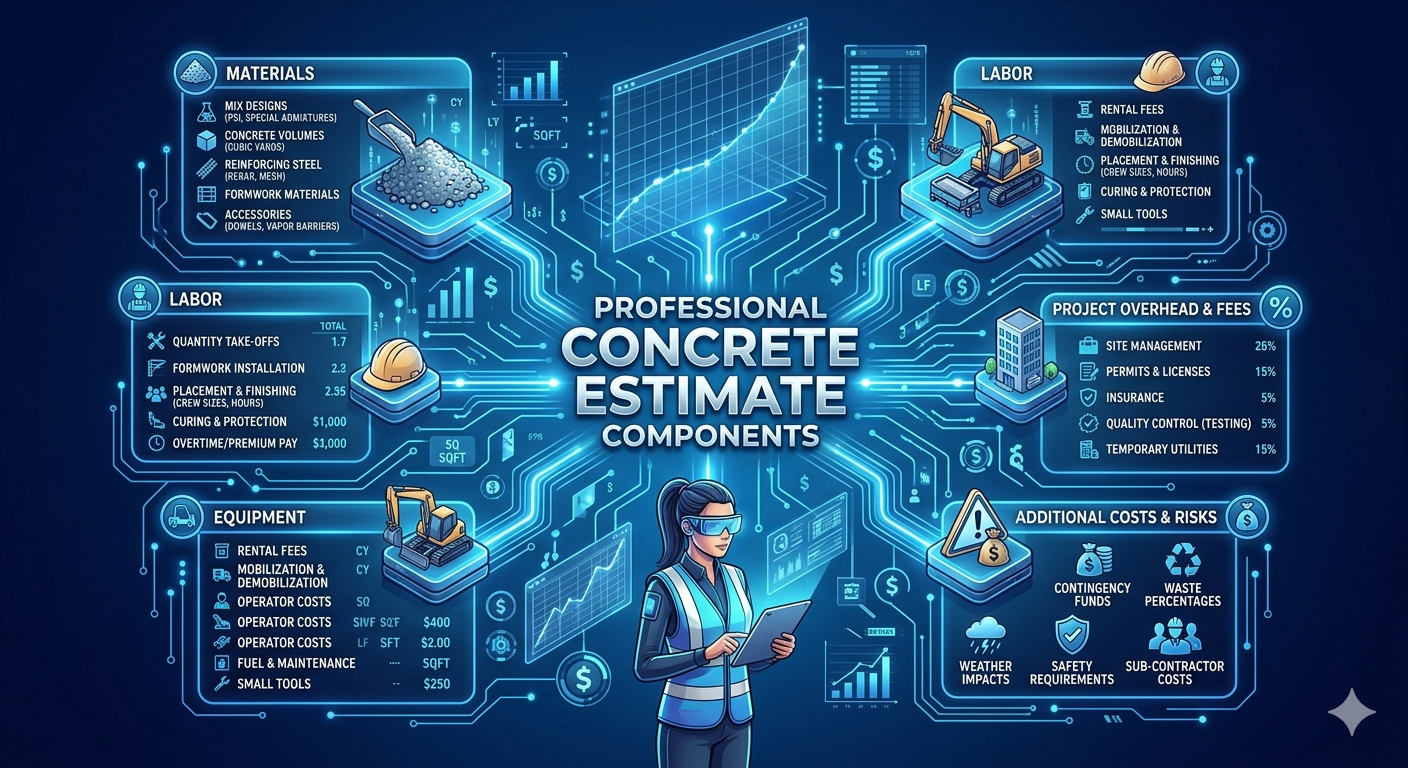
An estimate prepared by a professional concrete cost estimator will include all the factors involved in the cost of concrete. Below are the major components included in a complete concrete estimate.
1. Concrete Quantity Takeoff (Cubic Yards Calculation)
In concrete estimating, quantity calculation is the first step. The estimator takes measurements of slabs, footings, foundations, columns, and walls to determine the quantity of concrete. This is typically referred to in cubic yards.
Furthermore, the estimator takes into account slab thickness, footing depth and structural design requirements. Therefore, the takeoff becomes more accurate and reliable.
2. Concrete Mix Design and Material Specifications
Concrete is NOT uniform. Standard mixes are required for some jobs, and reinforced or high-strength concrete for others. A professional estimator will thoroughly examine the project specifications and add the proper PSI strength specifications to the estimate, which is why. In addition, they consider the slump, air entrainment, fiber, and special additives that may be needed depending on the weather conditions.
3. Reinforcement Steel (Rebar and Mesh)
Reinforcement steel is one of the most costly components of concrete construction. Rebar size, spacing, and placement will always be part of a detailed estimate. They are based on the structural drawings.
It is important to have a professional concrete cost estimator evaluate the amount of rebar needed, including lap splices, hooks, and structural overlaps. Furthermore, they contain quantities of wire-mesh, tying wire, chair and other accessories needed for the correct installation.
Reinforcement is essential to the strength of a structure and its absence can result in significant financial loss. Thus, the accuracy of reinforcement estimation is essential for contractors to have if they desire to have a profitable project.
4. Formwork and Shuttering Costs
Formwork is needed to mold and support concrete until it sets up. That is why a professional concrete estimator will take into account a full estimate for the formwork and shuttering. This includes quantities of materials, removal labor after curing and installation labor.
Furthermore, the estimator takes care of bracing, alignment and support work, particularly for walls, columns and raised slabs. In some instances, formwork can be hired on the basis of being purchased. As such, rental fees and costs based on time are also factored in where applicable.
5. Excavation and Site Preparation
Site preparation is essential before concrete can be poured. This is why excavation expenses for Footing, Foundation and Slab Bases are part of a detailed estimate. A concrete cost estimator, who is a professional, can make the calculations for excavation volume and if there is soil to remove, it will factor in the hauling or disposal costs.
The estimator also includes the price grading and leveling costs to prepare the site for concrete laying. Other base materials, such as gravel or sand, are also taken into account as are compaction requirements.
Additional stabilization may be required if the soil condition is poor. Hence, if project specifications require it, the estimator incorporates those costs.
6. Labor Cost Breakdown
Labor is more than just concrete pouring. It encompasses several stages, including layout, formwork, reinforcement, pouring, finishing and curing.
A concrete cost estimator is a professional who does a full labor analysis. This includes:
● Crew size requirements
● Total labor hours
● Productivity rates
● Skill level adjustments
● Overtime allowances
Also, the complexity of the project influences labour expenses. So it is important to have realistic and detailed labour calculations! This section ensures that contractors do not underbid.
7. Equipment and Tools Cost
Heavy equipment and special tools are necessary for concrete work. So detailed estimates feature:
● Concrete pumps
● Mixers (if required)
● Vibrators
● Installing screeds and finishing machines.
● Cutting tools
● Power trowels
● Forklifts or loaders
Furthermore, rental expenses involve the time of equipment, fuel, and the cost of the operator. As such, the estimate is an accurate reflection of actual job costs.
8. Concrete Finishing and Surface Treatments
The requirements will be different when the project is of a different type. Smooth power troweling, for instance, may be needed for industrial slabs. Driveways might require broom finishing in the meantime.
A detailed estimate could contain:
● Broom finish
● Trowel finish
● Stamped concrete
● Exposed aggregate finish
● Bulk moisture sealing and coating costs
Further, the decorative finishes need additional manpower. These costs are therefore provided separately in the estimator.
9. Curing, Protection, and Weather Adjustments
Curing concrete is an important aspect of the project Quality. But numerous contractors overlook the use of curing materials in estimates.
A professional concrete estimator will take into account curing costs, which are the following:
● Curing compounds
● Plastic sheeting
● Wet curing blankets
● Winter heating protection
● Avoid evaporating in hot weather. Don’t evaporate in warm weather.
Besides, weather influences the speed of the projects and also impacts the efficiency of labour. So, in the case of harsh conditions, an estimator may incorporate allowances for contingencies.
10. Waste, Spillage and Contingency Allowances
Concrete projects always have some waste. Spillages can occur during pumping, during over-excavation or leaks can form in the forms.
So one of the reasons professional estimates are done with percentages for waste is because of this. But they use reasonable waste factors, on their own and not random guesses. Furthermore, contingent allowances serve to help with unforeseen circumstances in the job. This, in turn, ensures that contractors remain protected.
Why Contractors Outsource Concrete Cost Estimators
Not enough contractors have time to oversee job sites and crews. Hence, they would like to hire concrete estimating companies to perform their concrete estimating jobs. Outsourcing reduces time and boosts the accuracy of bidders. Furthermore, contractors get specialist reports that are ready for submission.
Construction Estimator Supports Better Project Planning
Estimating concrete work is a component of the larger estimating project. A construction estimator is an individual who has the proper skills to help contractors in the planning of the exact amount of a project, as well as a schedule for the project.
Furthermore, concrete estimating is crucial for helping with:
● Better procurement planning
● Faster bid submissions
● Reduced change orders
● Stronger project control
So an estimate isn’t only a price tag. It’s also about the success of a project over time.
Final Thoughts
A professional concrete estimator isn’t just able to estimate cubic yards. These are the items that need to be added to the cost of the materials and include reinforcement, formwork, labour, equipment, finishing, curing, overhead and profit. Furthermore, they make sure that each and every cost is taken into account prior to bidding.
When contractors seek accuracy and time savings, it appears to be logical to outsource concrete estimator services. This helps in the better performance of bids and lessens financial risk.
Further, a professional construction estimator can assist contractors to remain organized, competitive, and lucrative in the modern construction sector.